

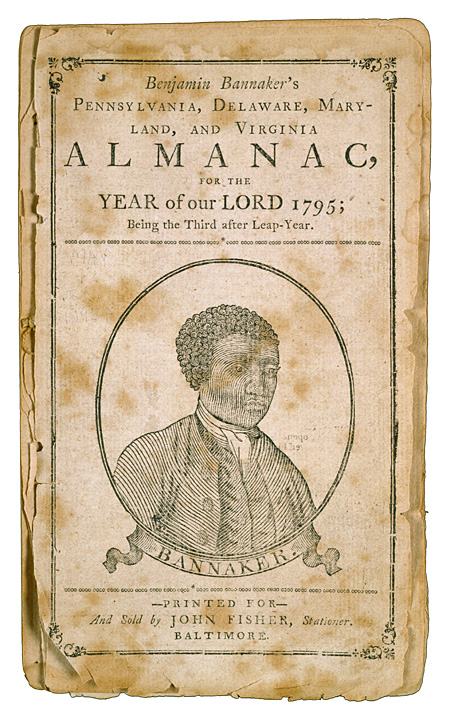
Benjamin Banneker, free man of color, is the first Black scientist

Oella
April 1, 1791

Benjamin Banneker is a free Black man and self taught astronomer and clock maker. The Quaker brothers John, Andrew and Joseph Ellicott give him books on astronomy.

He accompanies the Ellicott party that surveys the boundaries of Washington DC in 1791. The following year he publishes the first of six annual almanacs and writes to Thomas Jefferson, stating that men of color are intellectually equal to white men. Jefferson responds with intellectual respect but no commitment.

Banneker’s interest in astronomy and his scientific abilities make him the first and most accomplished Black person in 18th century America.

For More Information

Benjamin Banneker Historical Park and Museum

View Other Mosaic Pieces

Poole and Hunt Foundry becomes an industrial hub

The Poole and Hunt Foundry and Machine Works, opened in 1854, makes construction in the US Capitol possible, specifically the dome and the House and Senate wings. Poole and Hunt becomes an industrial hub with 700 employees on the Jones Falls after the Civil War.

Read More »

Rembrandt Peale builds the first museum

Rembrandt Peale opens the first purpose-built museum in the US in August, 1814. As a fine arts gallery, it is short-lived, becoming city hall, a school for “colored” children, city water offices and now Baltimore’s Community Museum.

Read More »

Land Recognition

We acknowledge the enduring presence of many American Indian tribes who once lived in Maryland and who now, having lost their lands, live in a diaspora. Read more.

© 2023 MARYLAND 400

Scroll to Top