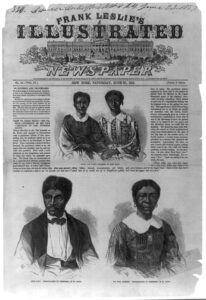


A free Black community 20 miles north of the Mason-Dixon Line in Pennsylvania successfully defends four escaped enslaved men from a Maryland posse armed with a warrant testing the “1850 Fugitive Slave Act.” When the escapees’ owner, Edward Gorsuch (1798- 1851) is killed, the incident causes national turmoil and becomes the first test of the federal legislation regarding escaped enslaved people. It is an important episode that leads to the Civil War.
Edward Gorsuch of Monkton, MD, considers himself a good owner of his 13 enslaved people. After four flee to Pennsylvania, Gorsuch obtains a federal warrant and is assigned a federal agent who accompanies his group to carry out an approved federal action as they attempt to recover fugitive slaves. He leads a posse overnight to a Black enclave in Christiana, PA. In the ensuing confrontation, Gorsuch is shot and killed, his son is badly injured and his party retreats.
With the aid of Frederick Douglass, the four escaped men flee to Canada. The ensuing national tumult causes President Millard Fillmore to call out marines who arrest 36 Black and 5 white men, charging 38 with treason. All are eventually acquitted and the abolition movement is emboldened by the event.