
Mary Pickersgill sews the flag that becomes the Star Spangled Banner

August 13, 1813

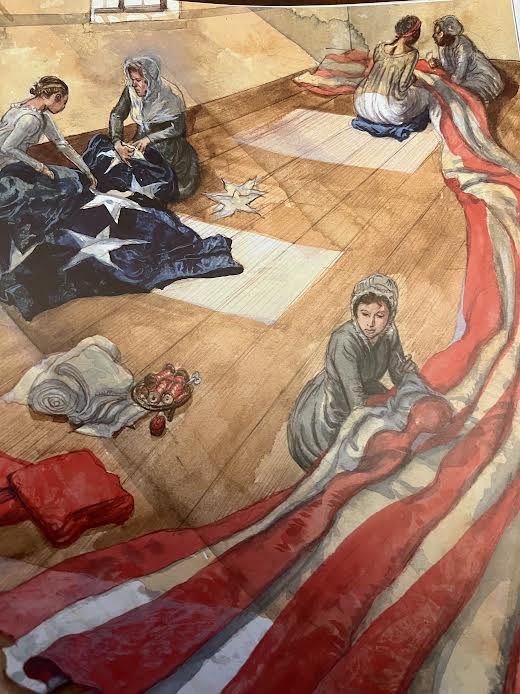
Mary Pickersgill (1776-1857), a successful Baltimore flag and banner maker, delivers a 30’ x 42’ flag, along with a smaller “storm” flag to the Ft. McHenry garrison. Calling on help from her family and neighborhood seamstresses, including indentured servants and Grace Swisher, a free young Black woman, Pickersgill works day and night for six weeks to sew the flag together in a local brewery. She becomes the premier flagmaker in the new nation.

Within a year, the Ft. McHenry flag gains immortality as the “Star Spangled Banner” during the Battle of Baltimore. The famous flag survives and is on display in the Smithsonian’s Museum of American History.

From 1828 to 1851, Pickersgill is president of the Impartial Female Humane Society, helping local disadvantaged women. It is the first such social agency of its kind. In 1850 the Aged Women’s Home is expressly built to offer shelter to older women, also the first such agency of its kind.
For More Information

Star-Spangled Banner Flag House

View Other Mosaic Pieces

Reaper developed on Carroll County Farm

Jacob R. Thomas, a Carroll County farmer, assembles a wheat reaping machine in 1811 and tries it out locally. It doesn’t cut well, but the first experiment with a mechanical reaper ushers in the age of agricultural machinery.

Read More »

Abolitionist William Lloyd Garrison begins his career in Baltimore

William Lloyd Garrison begins his abolitionist career, writing and coediting the newspaper, The Genius of Universal Emancipation in Baltimore in 1829. He is the most famous white American to devote his life to freeing the slaves. Photo shows Garrison (center) with two other abolitionists, Wendell Phillips and Englishman George Thompson.

Read More »

Land Recognition

We acknowledge the enduring presence of many American Indian tribes who once lived in Maryland and who now, having lost their lands, live in a diaspora. Read more.

© 2023 MARYLAND 400

Scroll to Top